
A Solstice note
New England Literary News

It’s the Solstice today. Happy Solstice to you. The deepest dark before the light begins its slow creep back. A moment, I hope, to find a minute, or more, to pause. To pause in the midst of this hurried harried merry melancholy overcommitted overstimulating time of year. To pause the wrapping, the buying, the to-do listing, the fret, the scroll, the rush. The sun is stilled, and we can be, too. To draw in and look out. To feel the smolder in the deepest parts, the spark of aliveness that binds us. It’s here to be found. And this past week and its particular strain of darkness, locally, globally, pours a shadow over the spark, which makes it all the more crucial to locate it, the glow in all the darkness. It’s here. It’s hard to find. But it’s here. And there’s a minute today for you to feel it. This is what the Solstice is for. To locate the spark, yours and everyone’s and everywhere’s. Before you race off for more butter, to buy one last present for your nephew, before you have to ready yourself for the next egg nogged hurrah. A pause, the spark, the glow, the light that feels so hard to locate that’s here, with us, and making its return.
And below, a few more offerings from the archives for your reading and gift-giving needs, with my wishes for calm, health, warmth, safety, safety, safety, comfort, laughter, for you, for everyone you love, for everyone.
In 12th century Germany, Hildegard of Bingen, mystic, writer, composer, philosopher, began having visions. In And Again I Heard the Stars (Spuyten Devil), a pulsing, sensual debut poetry collection, Somerville-based poet Christie Towers intertwines with Hildegard. These are poems of desire and yearning, and the flames that define the feeling, sometimes smoldering warm and low, sometimes burning bright and hot: “provoked swollen or intensified red / luminosity a strong feeling a quickening / arousal a source of illumination.” Towers’s lines are grounded in “a body entire,” and she treads the thread between the flesh, its heated presence, and the ecstatic, the joining — or the desire to join — with something or someone outside yourself. “I speak as one / in doubt taught inwardly great / secrets,” Towers writes. She wonders what arises from the heat of not having, not knowing, and her answers are charged with the touch of feathers and stars.
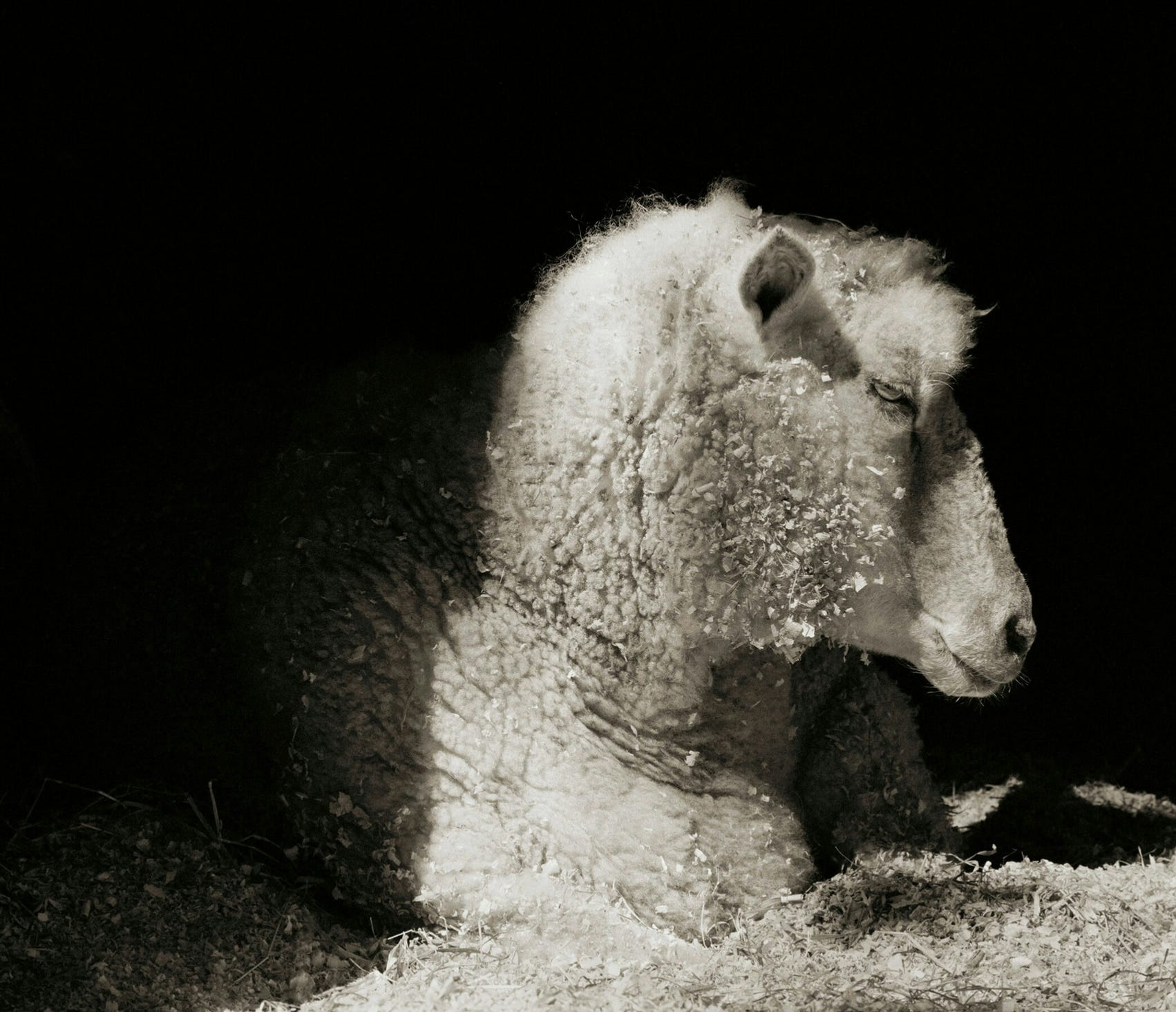
The images in Salem, Mass-based photographer Isa Leshko’s book Allowed To Grow Old: Portraits of Elderly Animals from Farm Sanctuaries (University of Chicago) reveal the quiet dignity of creatures long in years, animals spared the gun or the kill boxes of industrial slaughter and allowed to live out their days. The black and white photographs show a horse standing in the doorway of a barn, an empty black socket where its eye should be; a rooster crouches beneath a hutch, feathers gone on a section of wing to reveal a row of dry spaghetti bones; a 24-year-old donkey named Babs looks down, shaggy-faced, weary; a 21-year-old goat named Abe with milky eyes stands in profile with enormous gravitas. What Leshko shows, above all, is life, the spark and heat that lives in the faces of these animals, each one individual, singular, living.
Éireann Lorsung makes things happen. Her work makes me move more generously and more attentively through the world and if there’s a higher praise for poetry, I’m not sure what it is. With her recent Pattern-book (Carcarnet), she continues to surpass herself. The book is magnificent, with poems of place (Ghent, Minneapolis, Iowa), of fields, rivers, weeds, of language. “Is there a way to touch the is that is ‘the bird’?” And in her altering collection, The Century (Milkweed), Lorsung demands, not explicitly, but with the force of the depth of her inquiry, that we examine and re-examine the history of which we are part, as well as the histories we believe ourselves not to be part. Never didactic, offering up only her example, she reminds us, “No excuse not to work, even / if the labor comes too late; even if, / in the beginning, it is poorly done, / as beginners’ work often is.” And that it is possible to have “some moral comfort or some social comfort, but not both.”
An inability to name what’s being felt makes feelings “seem not just unknown but unknowable,” writes John West in his lyrical, crystalline memoir Lessons and Carols: A Meditation on Recovery (Wm. B. Eerdman). Structured to echo the “nine carols and nine tiny lessons” developed in 1880 by a Canterbury bishop for Christmas, the book, in precise and delicate detail illuminates West’s relationships with alcohol and addiction, with depression, desire, with his new daughter, with sobriety, bipolarity, resentment (”a name for a memory left too long in warm, damp place”), with recovery. West’s fragments and stories have the feel of winter stars in a nightsky, focused distillations of light burning through darkness. He brings Catullus into it, and Wittgenstein, Robert Hass, John Ashbery, and Anne Carson, among others. “Translation is a lossy process,” he writes. The effort, his effort, is translating what defies language into words. A bird has a name, though one might not know it, and sometimes bird — its fluttering, its feathered wings, its tiny beating heart, its flight — is enough, has to be enough.

You’re invited to celebrate the Solstice this afternoon at 4:30 pm in Lincoln, Massachusetts. Poet and minister Nate Klug has invited me to read from Winter Solstice, and there will be Celtic music, and there will be a bonfire. The details are here. I’d love to see you, in whatever state this finds you, solemn, celebratory, some in-between.
And again, wishing warmth, calm, safety, comfort, laughter to you all.
Thank you, Nina, for continuing your indispensable column. Writers and readers are so grateful to you. What idiots at the Globe for letting you go. Everyone who can should subscribe!
What a nourishment, Nina—you help us read into the world and each other!